
Online learning
How can an Interdisciplinary degree prepare you for jobs that AI can’t replace?
Key takeaways
- “AI-proof” is best understood as career resilience, not a guarantee that technology will never affect a job.
- Human-centred capabilities such as analytical thinking, adaptability, leadership and creativity remain highly valued by employers.
- Interdisciplinary learning helps you connect technological change with culture, history, ethics, organizations and human behaviour.
- People-centred careers in management, communications, public service and community engagement continue to rely heavily on judgement, context and relationships.
- uOttawa’s Bachelor of Arts, Interdisciplinary Studies (Online, Accelerated) builds on prior college education while developing portable skills for an AI-shaped workforce.
Statistics Canada estimates that 60% of Canadian employees aged 18 to 64 were in jobs that may be highly exposed to AI-related transformation, including 29% in roles where AI may be highly complementary and 31% where complementarity may be lower.
Importantly, these are experimental exposure estimates, not predictions that 60% of jobs will disappear.
That distinction is important, as true career resilience isn’t about finding work technology will never touch. It’s about developing capabilities that continue to hold value as tools and industries change.
An interdisciplinary degree can support that resilience by strengthening critical thinking, communication, judgement, creativity, digital fluency and the ability to connect ideas across contexts.
What does “AI-proof” mean in the age of artificial intelligence?
“AI-proof” means building career resilience through skills that stay useful as technology changes, not finding a job AI will never affect.
AI systems are already influencing work across sectors. The World Economic Forum reports that employers expect 39% of workers’ existing skill sets to be transformed or become outdated between 2025 and 2030.
At the same time, human-centred abilities remain central. In the World Economic Forum’s 2025 employer survey, 69% identified analytical thinking as a core skill, 67% identified resilience, flexibility and agility, 61% identified leadership and social influence and 57% identified creative thinking.
Why are AI-proof jobs often built around human judgement rather than routine tasks?
Jobs become more resilient when they depend on context, accountability, emotional intelligence and decisions that don’t have one predetermined answer.
Routine and repeatable tasks can often be automated or supported by technology. People-centred work is different.
It may require work only a human can do, like weighing competing priorities, interpreting incomplete information, fostering human connection, understanding motivations and deciding what makes sense in a particular situation.
That’s also where critical thinking becomes vital.
An AI tool can generate a recommendation or identify a pattern, but a professional still needs to determine whether the output is relevant, accurate and appropriate for the people affected by it.
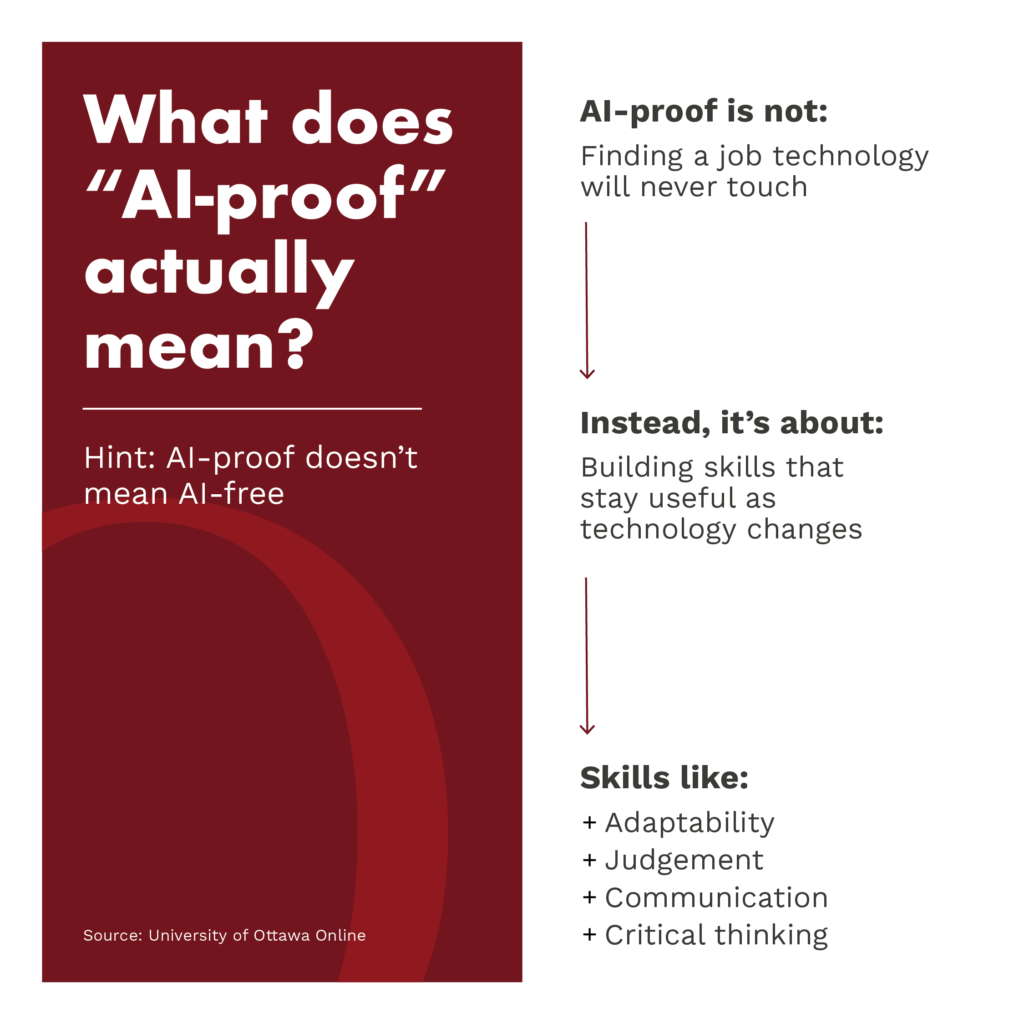
Hint: AI-proof doesn’t mean AI-free
How do AI tools change the skills professionals need?
AI tools increase the value of combining digital fluency with the ability to question, interpret and communicate.
The World Economic Forum ranks technological literacy among today’s core workforce skills while also identifying strategic thinking, creativity, resilience and leadership as highly important.
The most adaptable professionals will be able to use technology without outsourcing their judgement to it.
That means understanding what a tool can do, recognizing what it may miss and turning information into decisions or messages that make sense to other people.
Which AI skills matter even if you don’t want a technical career?
The most useful AI skills for many nontechnical careers are critical evaluation and knowing when human expertise should take priority.
In practice, that can mean evaluating generated information and AI automation rather than accepting it at face value, identifying missing context, communicating complex ideas clearly and considering how technology affects people and institutions.
It also means combining digital fluency with critical reasoning. As tools become easier to use, knowing what to ask, what to question and what to do with the answer becomes increasingly important.

AI can generate. Humans add meaning.
Why are AI ethics and human perspectives important?
Human perspectives matter because technology decisions can affect people, organizations and communities far beyond the teams that build the tools.
Questions surrounding AI tools can involve responsibility, fairness, agency, consequences for human workers and appropriate use.
Those conversations aren’t just limited to engineers. Managers, communicators, public-sector professionals, community leaders and others may all need to think critically about how technology is introduced, explained and used.
uOttawa’s broader Human Intelligence for human futures initiative similarly emphasizes judgement, critical thinking, communication, collaboration and empathy in a technology-shaped world.
How does a Bachelor of Arts develop complex problem-solving across disciplines?
A Bachelor of Arts can strengthen complex problem-solving by teaching you to examine an issue through more than one disciplinary lens.
At uOttawa, the Bachelor of Arts, Interdisciplinary Studies (Online, Accelerated) includes studying global history, Canadian culture, literature, architecture, environmental studies and Indigenous thought.
Students can also encounter digital cultures, ethics, agency, identity and society, as well as communication, interpretation and critical analysis.
That breadth is important because complex workplace problems rarely stay inside one category.
Interdisciplinary study helps you understand that context before jumping to a solution. It also gives you opportunities to draw connections, compare perspectives and make decisions when there isn’t a single obvious answer.

Why do creative professionals and creative directors benefit from human-first skills?
Creative professionals benefit from human-first skills because generative tools can assist with production, but people still provide direction and purpose.
A creative director, for example, needs more than the ability to produce content. They need to interpret goals, understand cultural context, make strategic choices that shape narratives, guide collaborators and decide which ideas are worth developing.
Producing more options isn’t the same as knowing which option is right.
Interdisciplinary learning can strengthen that creative judgement. Exposure to different fields gives you more references to draw from and can help you move beyond predictable patterns. Creativity becomes more useful when it’s paired with communication, critical analysis and an understanding of people.
Which people-centred career paths may align with AI-proof jobs?
People-centred career paths can offer resilience when human interaction, interpretation, accountability and judgement remain central to the work.
However, “AI-proof jobs” shouldn’t be read as occupations guaranteed to avoid automation. A more useful way to think about them is as career areas where human capabilities remain meaningful even as the tools used to perform the work evolve.
Here are some examples:
Management careers
Leadership roles, program management, operations management, team coordination and business transformation can involve balancing priorities, communicating across functions and making ethical decisions in changing conditions.
Communications careers
Communications management, public relations, organizational communications, community engagement and content strategy rely on audience understanding, interpretation, trust and purposeful messaging.
Public service and policy work
Policy coordination, public administration, data analysis and stakeholder consultation can require professionals to consider evidence, public impact, institutional context and competing interests.
Education roles
Teachers, teaching aides and other educators require human insight, empathy, understanding and a drive to help students succeed. AI can assist with grading but not with relationship building, comforting a struggling student, adapting lessons to individual student needs or leading debates.
Community engagement and nonprofit work
Roles such as program coordinator, nonprofit program manager, policy and advocacy coordinator and community development officer rely heavily on relationships, context and an understanding of the communities being served.
How can an interdisciplinary degree make your skills more portable across career changes?
An interdisciplinary degree can make your skills more portable by developing capabilities that aren’t tied to one platform, tool or job title.
Transferable capabilities such as critical thinking, communication, ethical judgement, creativity, digital fluency, cultural literacy and interdisciplinary problem-solving can move with you across employers, industries and job functions.
That portability is valuable in a labour market where the work itself is evolving.
It can support movement across management, communications, policy, community engagement and other people-centred fields without requiring your entire professional identity to depend on one technology.
Strengthen the human skills the new economy values at uOttawa
uOttawa’s Bachelor of Arts, Interdisciplinary Studies (Online, Accelerated) gives college-credentialed adults a way to build on what they’ve already earned while developing human-centred capabilities for a changing workforce.
Delivered 100% online, the program is designed to recognize prior college learning and develop transferable skills such as critical thinking, communication, judgement, creativity, digital fluency and interdisciplinary problem-solving.
If you’re ready to build on your college diploma and sharpen the human skills AI can’t replicate in the new economy, request more information today.
Key terms
- AI-proof: A shorthand for career resilience in the face of technological change, not a guarantee that a job will never be affected by AI.
- Artificial intelligence: Technologies that perform tasks associated with human intelligence, such as generating content, recognizing patterns or making predictions.
- Digital fluency: The ability to use digital tools thoughtfully while understanding their capabilities, limits and context.
- Human-centred skills: Capabilities such as judgement, communication, empathy, creativity and critical thinking that rely heavily on human context and interaction.
- Interdisciplinary degree: A degree that brings together perspectives, methods and subject areas from multiple disciplines.
- Interdisciplinary problem-solving: Approaching a complex problem by connecting insights from more than one field or perspective.
- Transferable skills: Capabilities you can apply across different roles, industries and career stages.