

Online learning
How an Interdisciplinary degree prepares you for policy analyst jobs in Canada
Key takeaways
- Policy analyst jobs in Canada often involve researching complex issues, evaluating evidence, developing recommendations and communicating findings to decision-makers.
- Interdisciplinary study can strengthen the critical thinking, judgement, research and communication skills that support policy development.
- Policy careers span areas such as social policy, education, health, government relations and regulatory affairs, but requirements vary by field and employer.
- Human skills remain important as AI changes knowledge work. The World Economic Forum reports that 69% of surveyed employers consider analytical thinking a core workforce skill.
- uOttawa’s Bachelor of Arts, Interdisciplinary Studies (Online, Accelerated) lets eligible college diploma holders build on prior education while developing transferable skills for policy-related and cross-sector work.
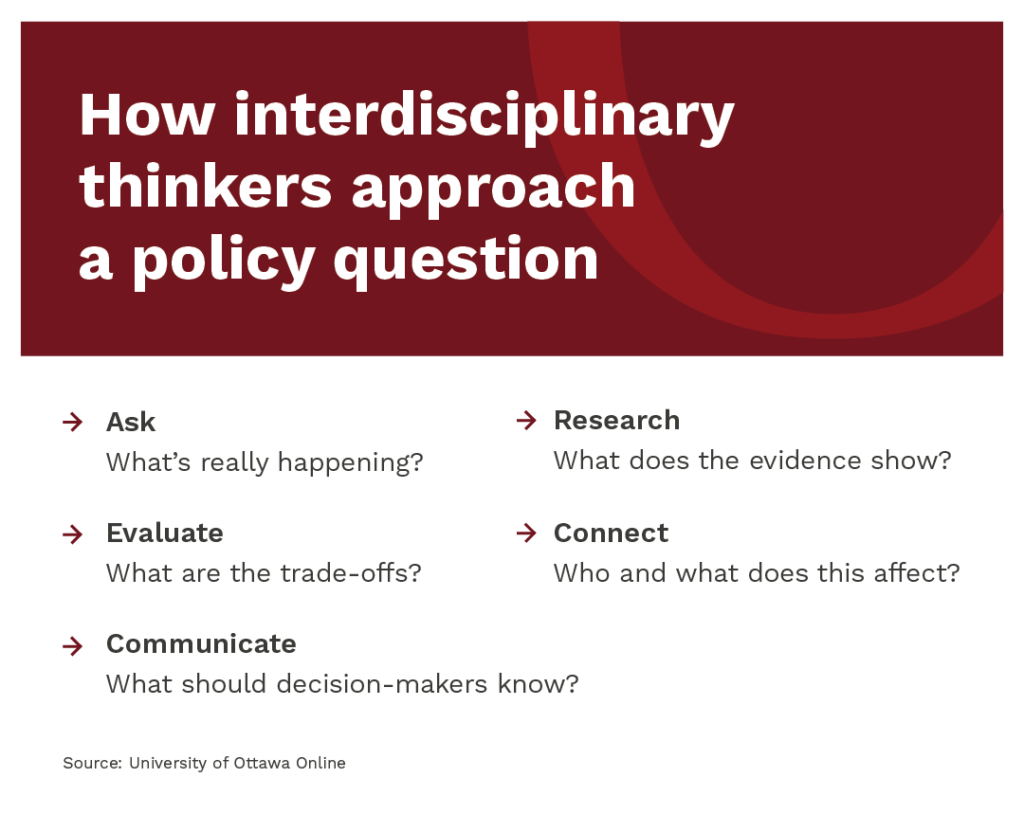
Policy analysts rarely work with simple questions. They may need to understand a problem, weigh evidence, consider who could be affected and communicate options in a way decision-makers can use.
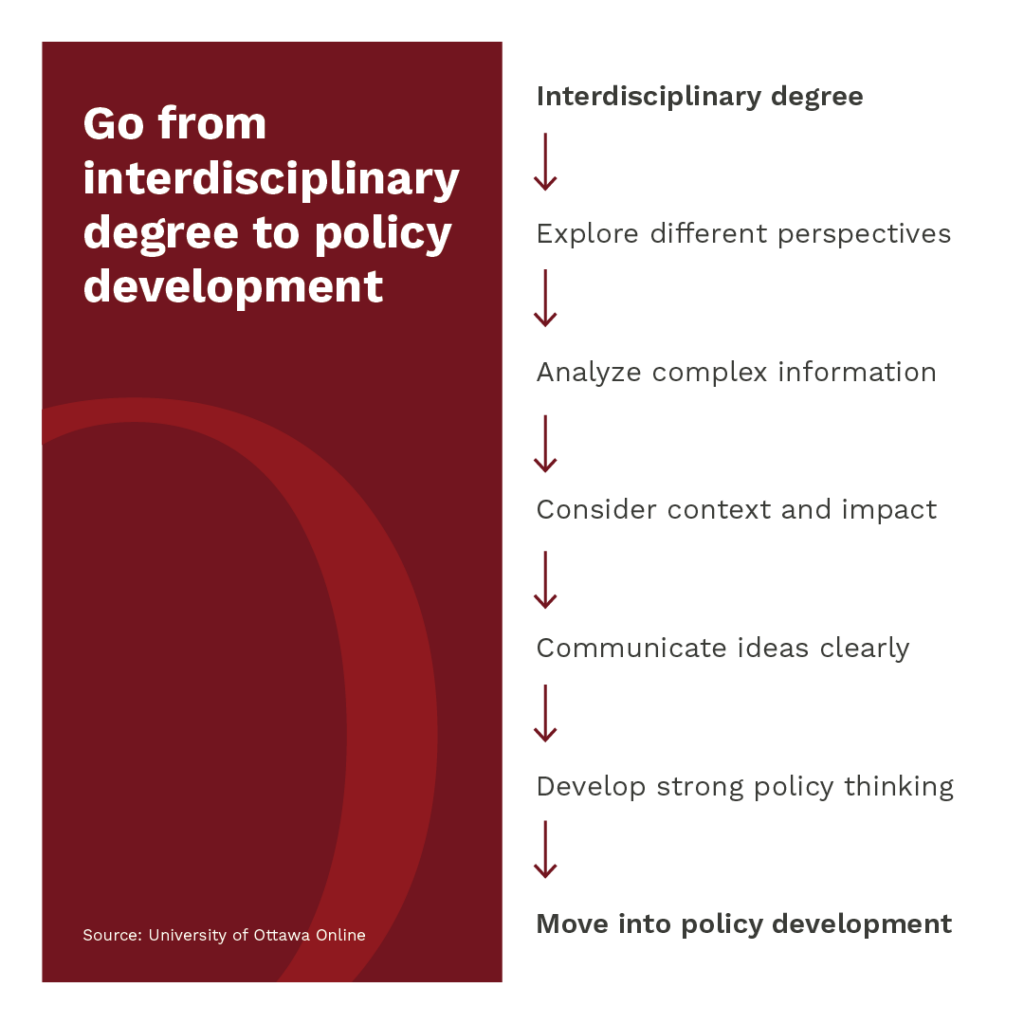
An interdisciplinary degree can provide a useful foundation for that type of work because it teaches you to examine questions from more than one perspective.
Instead of seeing a social, cultural, economic or technological issue in isolation, you learn to connect context, evidence and human impact.
What does a policy analyst do in Canada?
A policy analyst researches issues, evaluates information and helps turn evidence into policies, programs, recommendations or advice.
However, the exact work depends on the policy field.
Social policy professionals, for example, may research demographic, social and economic developments to inform legislation, programs or proposals.
That can translate into responsibilities such as reviewing quantitative and qualitative research, project management, studying sustainability and environmental legislation, comparing options, consulting stakeholders and preparing reports or briefing materials.
How can an interdisciplinary degree support policy development?
An interdisciplinary degree teaches you to connect information, context and perspectives across different areas of knowledge, which is important, as policy challenges don’t always fit neatly into one academic discipline.
A housing question may involve economics, community needs, regulation and social conditions. A technology policy could raise questions about culture, access, ethics and human behaviour.
Understanding those intersections can help you ask better questions before moving toward a recommendation. It can help you practice moving from “What does the evidence say?” to equally important questions such as “What does it mean in this context?” and “Who could be affected?”
Which human skills can help you succeed as a policy analyst?
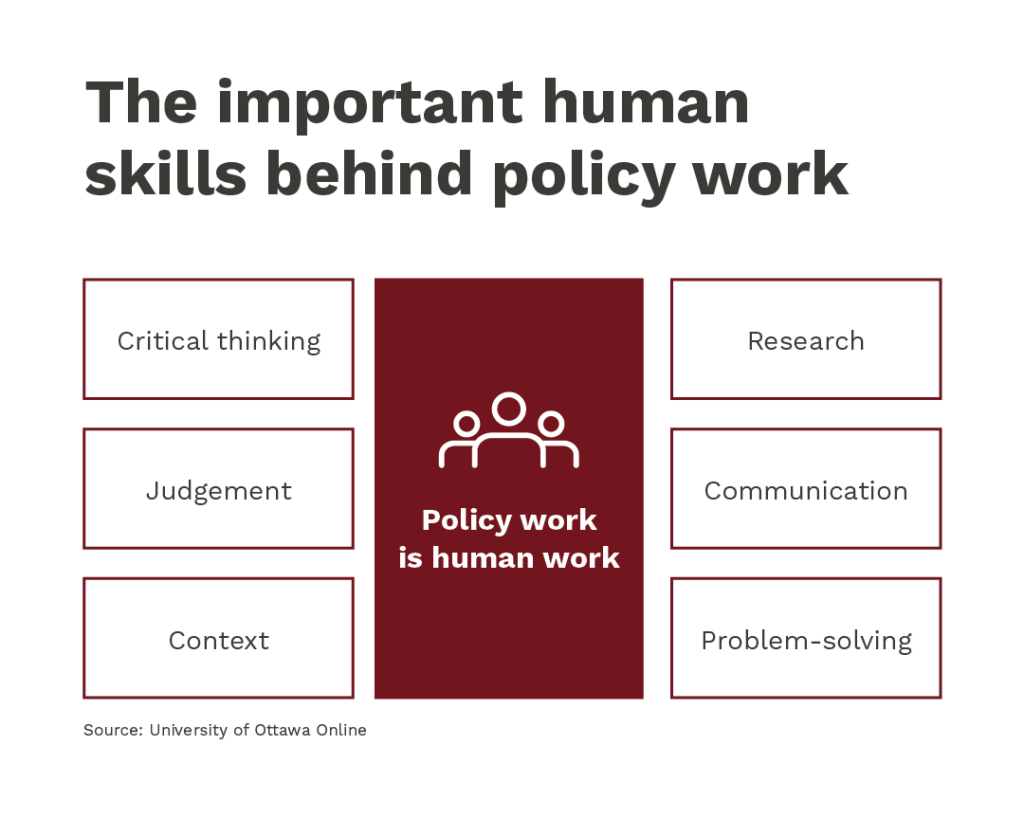
Critical thinking, judgement, communication, organization, research and problem-solving can all help you navigate the complexity of policy work.
These capabilities are valuable because policy analysis involves interpretation, not just information retrieval. Canada’s Job Bank identifies competencies such as decision-making, digital literacy, sound judgement, writing and reading comprehension within policy-related occupations.
They’re also becoming increasingly relevant in a changing workplace.
The World Economic Forum’s Future of Jobs Report 2025 found that 69% of employers identified analytical thinking as a core skill of successful candidates. Resilience, flexibility and agility followed at 67%, leadership and social influence at 61% and creative thinking at 57%.
How can policy analyst jobs connect to research analyst, government relations and regulatory affairs work?
Policy analysis connects to several related career areas, but the roles aren’t interchangeable, and qualifications can differ significantly.
- Research analyst: Research-focused roles typically emphasize gathering evidence, analyzing information and producing reports.
- Government relations: Key hiring sectors for policy analysts include federal, provincial and municipal governments. This work can involve understanding public policy priorities, supporting stakeholder relationships and helping organizations engage with governments.
- Regulatory affairs: These roles may involve interpreting regulatory requirements, supporting compliance, monitoring policies and business processes and preparing submissions to regulatory bodies. This often involves working in collaborative environments with senior management.
Some positions require specialized technical knowledge, consulting and sector experience or a master’s degree, so review the requirements for the type of work you want to pursue.
How do research analyst roles fit into a longer-term senior advisor or policy career?
Research analyst roles can help you build experience in evidence gathering, analysis, reporting and recommendation development that may also be relevant to policy work and senior roles.
As your experience grows, you may take on increasingly complex research questions, stakeholder relationships and strategic responsibilities.
An interdisciplinary degree can provide an academic foundation, while your work experience can help you build knowledge within a particular policy area.
What kinds of policy analyst jobs in Canada can you explore with an interdisciplinary degree?
An interdisciplinary education can prepare you for several broad policy areas, although the specific credentials required depend on the employer and subject matter.
Potential areas include social policy, where work may relate to employment, immigration, housing, labour, human rights or family services, and education policy, where professionals research, report on and administer education policies and programs.
Health policy is another field, along with economic, scientific and regulatory policy roles.
The takeaway is that “policy analyst” isn’t one standardized job. Your degree can build a foundation, but your target field should help shape the courses, experience and additional qualifications you pursue.
How does interdisciplinary thinking strengthen policy development in an AI-shaped workplace?
Interdisciplinary thinking helps policy professionals evaluate AI-generated information within the broader human, institutional and social context where decisions are made.
AI can accelerate tasks such as summarizing documents or organizing information. It can’t remove the need to ask whether information is credible, relevant or appropriate to a particular situation.
Policy decisions can involve competing interests, imperfect evidence and consequences that don’t reduce to one automated answer.
The World Economic Forum estimates that 39% of workers’ existing skill sets will be transformed or become outdated between 2025 and 2030. At the same time, analytical thinking remains employers’ top-ranked core skill.
That helps explain the value of combining digital fluency with distinctly human capabilities.
How can a Bachelor of Arts build on your college diploma for policy-focused career growth?
A Bachelor of Arts can help you add a university credential and broader analytical capabilities to the college education and work experience you’ve already built.
For eligible college graduates, uOttawa’s Bachelor of Arts, Interdisciplinary Studies (Online, Accelerated) is designed to recognize prior college learning rather than requiring you to start again.
The 100% online program offers pathways for graduates of two-year and three-year accredited Canadian college diplomas, with the exact pathway based on your previous credential and educational background.
The degree is also designed with public service and policy-related work among the broad career areas students can explore.
How can you start preparing for policy analyst opportunities while earning your degree?
You can prepare for policy work before graduation by deliberately practising research, analysis and concise communication.
Follow current policy questions. Save strong academic work that demonstrates your ability to research an issue and communicate conclusions clearly.
You can also look for opportunities in your workplace or community to contribute to research, program evaluation, consultations or briefing materials.
Most importantly, read job descriptions in your preferred policy field early. They’ll help you identify technical knowledge, sector experience or additional education you may need alongside your bachelor’s degree.
Explore the Bachelor of Arts, Interdisciplinary Studies (Online, Accelerated) at uOttawa
The Bachelor of Arts, Interdisciplinary Studies (Online, Accelerated) is 100% online and designed for college-credentialed adults.
Develop transferable capabilities that can support opportunities across public service, policy-related work, communications, management and other cross-sector careers.
Request information to explore your pathway and see how you can build on your college diploma.
Key terms
- Policy analyst: A professional who researches policy questions, evaluates evidence and helps develop recommendations, policies or programs.
- Policy development: The process of researching an issue, considering options and impacts and developing approaches to address it.
- Interdisciplinary degree: A degree that draws on multiple academic perspectives rather than approaching questions through one discipline alone.
- Stakeholder: A person, community or organization that may affect or be affected by a policy or decision.
- Research analyst: A professional who gathers, evaluates and synthesizes information to support decisions, reports or recommendations.
- Government relations: Work focused on engagement, consultation and relationships between organizations and governments.
- Regulatory affairs: Work involving regulatory requirements, compliance, policy changes and interactions with regulatory bodies.
- Evidence synthesis: The process of bringing information from multiple credible sources together to support analysis or decision-making.