
Online learning
Looking for degree completion programs? Here’s why an Interdisciplinary degree is a great choice
Key takeaways
- Degree completion programs can help college graduates build on the education they’ve already earned instead of starting a bachelor’s degree from scratch.
- Credit transfer can reduce the amount of study still required, but the exact pathway depends on your previous credential and academic background.
- Interdisciplinary study can complement specialized college training with broader skills such as critical thinking, communication, judgement and creativity.
- Human skills remain highly relevant as AI and automation reshape tasks, roles and the skills employers need.
- Fully online degree completion can make university study more realistic for working adults who need to balance school with work and other responsibilities.
Degree completion programs help eligible learners build on their previous education and work toward a bachelor’s degree through a pathway that recognizes what they’ve already accomplished.
For college graduates, an interdisciplinary degree can add another layer of value.
Instead of replacing the practical or technical knowledge you already have, it can broaden how you think, communicate and approach complex questions across different contexts. Degree holders also tend to enjoy higher earnings and job role potential.
What should you look for when comparing degree completion programs?
A strong degree completion program should recognize your previous education, make your remaining pathway clear and fit realistically into your life.
As you compare options, look for:
- Admission requirements, including minimum GPA and recognition of prior college coursework so you aren’t unnecessarily repeating previous learning
- A transparent credit transfer process that shows how your existing credential may affect your degree requirements
- Recognition of prior learning through assessments for work or military experience
- A delivery format that works with your career, family and personal responsibilities
- A curriculum that adds new capabilities to the practical or technical knowledge you already have
- Academic and student support that can help you transition back into university-level study
The goal isn’t simply to find the fastest program. It’s to understand what you’ll gain from the remaining coursework and how well the pathway supports your next step.
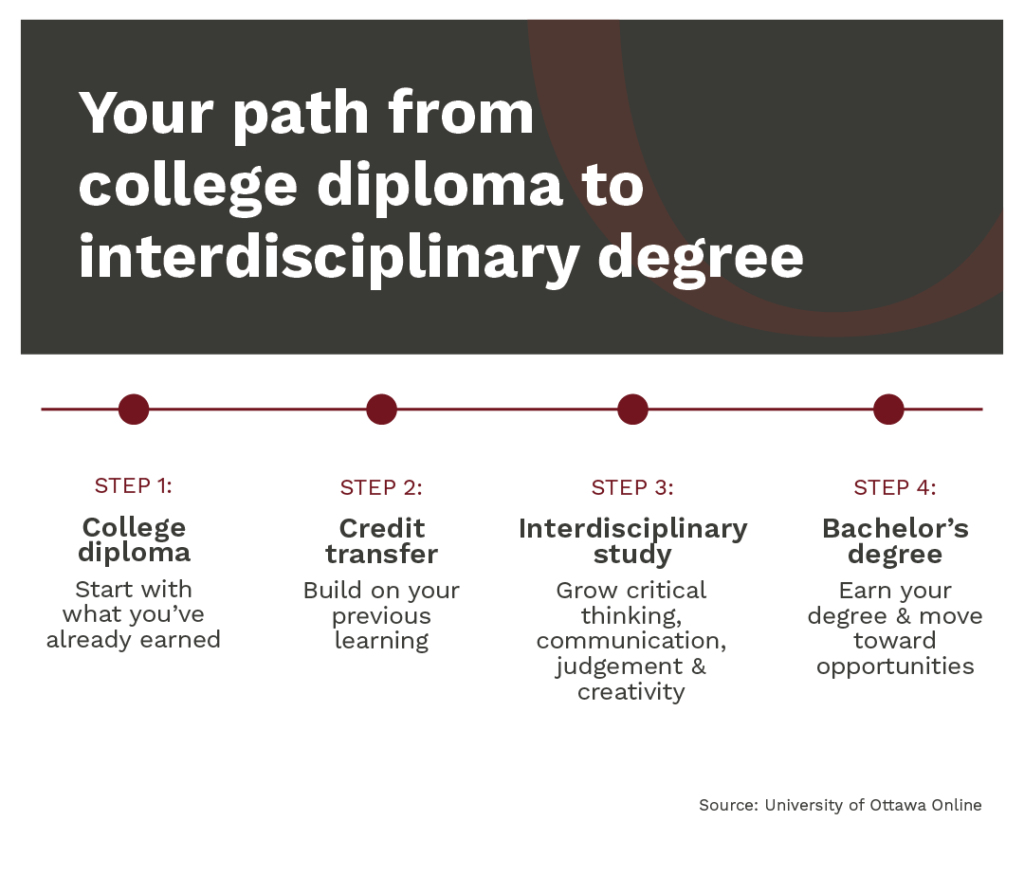
How can a college diploma and credit transfer help you complete a degree sooner?
A college diploma can shorten your route to a bachelor’s degree when a program recognizes eligible prior learning through transfer credit.
The amount of credit you receive can vary based on the type and length of your diploma, your academic background and the university’s policies.
That’s why it’s worth asking about transfer credit early. A clear assessment can help you understand your remaining courses, likely completion timeline and overall academic plan.
At uOttawa, the Bachelor of Arts, Interdisciplinary Studies (Online, Accelerated) is designed for learners with a two-year or three-year accredited Canadian college diploma. The program recognizes prior college learning at admission, with the exact pathway depending on your previous credential and educational background.
Why can interdisciplinary studies be a strong choice for degree completion?
Interdisciplinary studies can be a strong choice because they add breadth to the specialized knowledge you may already have from college.
Rather than staying inside one narrow subject area, interdisciplinary learning brings together ideas, methods and perspectives from multiple fields, such as psychology, language, business and more. That can help you examine problems from different angles, make connections between subjects and understand why an issue may look different depending on the people or communities involved.
An interdisciplinary degree also builds skills that stay useful as your responsibilities change.
Instead of preparing for only one job title, it can strengthen ways of thinking and working that carry across roles and sectors.
How do interdisciplinary studies connect the social sciences, humanities and contemporary issues?
Interdisciplinary studies connect these areas by helping you examine current questions through historical, cultural, social and ethical perspectives.
At uOttawa, areas of study include global history, Canadian culture, literature, environmental studies, Indigenous thought, digital cultures, ethics, agency, identity and society, along with communication, interpretation and critical analysis.
That can help you move beyond simply asking what is happening. You can also ask why it’s happening, whose perspectives are involved, what context matters and what the consequences may be.
These habits of inquiry are valuable when you’re working with people, information and change.
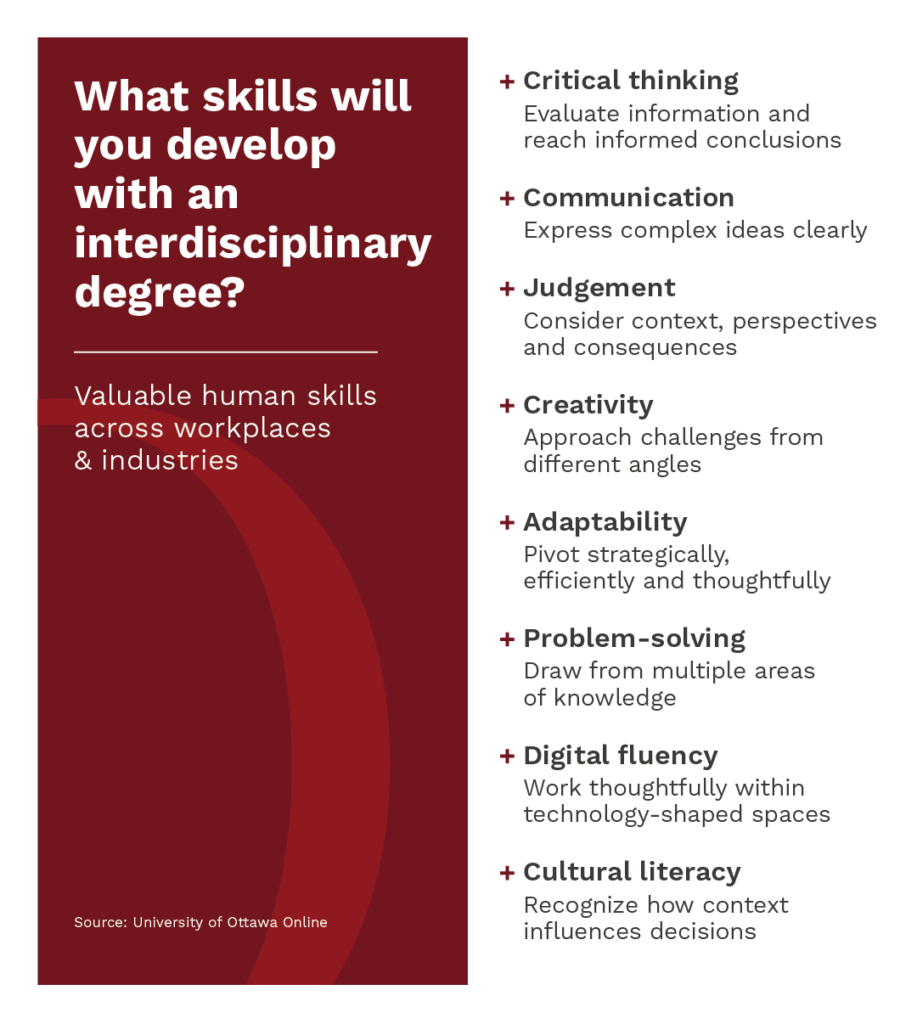
Valuable human skills across workplaces & industries
Why do human skills matter when choosing a degree completion program?
Human skills matter because AI and automation can change how work gets done, while increasing the value of people who can interpret context, communicate meaning and make thoughtful decisions.
The World Economic Forum’s Future of Jobs Report 2025 found that 39% of workers’ existing skill sets are expected to change or become outdated by 2030. It also identified analytical thinking as a core skill for 69% of employers surveyed, followed by resilience, flexibility and agility at 67%, leadership and social influence at 61% and creative thinking at 57%.
That mix is important. Technology skills are growing quickly, but so are capabilities that help you decide how, when and why to use technology effectively.
How can a part-time online degree fit around a full-time job?
A part-time online degree can make returning to university more realistic if you need to keep working or manage other responsibilities while you study. Currently, over 40% of online undergraduates are working adults.
However, look beyond the word “online” and consider how the program is structured.
Ask how courses are scheduled, how much weekly work is expected, what support is available and how different course loads affect your completion date.
A fully online, part-time program can remove commuting from the equation. It can also let you keep gaining professional experience while working on a more flexible schedule toward your degree.
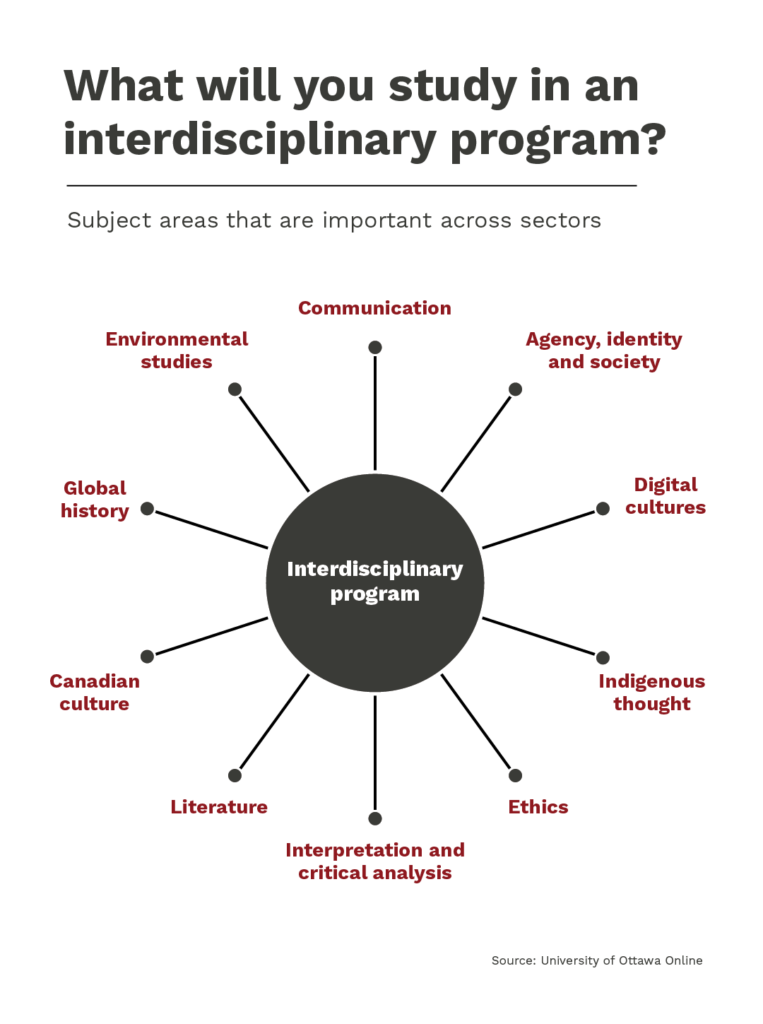
Subject areas that are important across sectors
What career paths can degree completion through interdisciplinary studies support?
An interdisciplinary degree can support career growth across roles that depend on communication, coordination, analysis and the ability to work across different priorities.
Potential directions can include:
- Program coordination and management
- Operations and administration
- Communications and community engagement
- Public service and policy-related work
- Nonprofit and social impact work
- Cross-sector leadership in areas such as education, healthcare, technology, data science and trades-adjacent organizations.
Keep in mind that a degree doesn’t guarantee a specific role. Your experience, industry knowledge, network and additional qualifications will still matter.
The advantage of interdisciplinary study is that it can strengthen transferable capabilities you can apply in more than one direction.
How can you decide whether an interdisciplinary degree is the right next step after your college diploma?
An interdisciplinary degree may be a strong next step if you want to build on your existing education while broadening the skills and perspectives you can use throughout your career and in everyday life.
Ask yourself whether you want a bachelor’s degree that complements your college training rather than repeats it. Consider whether your future roles require a university credential, broader capabilities or both. Then compare the pathway, flexibility, student support, curriculum and time remaining to completion.
Most importantly, look at what the degree helps you become better at.
If you want to strengthen critical thinking, communication, judgement, creativity and interdisciplinary problem-solving while keeping the expertise you’ve already built, an interdisciplinary approach may align well with where you want to go.
Learn more about uOttawa’s Bachelor of Arts, Interdisciplinary Studies (Online, Accelerated)
uOttawa’s Bachelor of Arts, Interdisciplinary Studies (Online, Accelerated) is a 100% online pathway designed for college-credentialed adults who want to build on a two-year or three-year accredited Canadian college diploma.
The program combines degree completion with a human-first approach to learning.
Request information to learn more about admission requirements, transfer recognition, your potential pathway and next steps.
Key terms
Degree completion program: A pathway that allows eligible learners to build on previous postsecondary education toward a bachelor’s degree.
Transfer credit: Academic credit granted for eligible learning completed at another recognized institution.
Prior learning: Education or learning completed before entering a new academic program.
Interdisciplinary studies: An approach that draws on more than one field to examine ideas, questions and problems.
Transferable skills: Skills that can be used across different roles, industries and work settings.
Human skills: Capabilities such as critical thinking, communication, judgement, creativity and adaptability that rely heavily on human context and interaction.
Digital fluency: The ability to use, interpret and work thoughtfully with digital tools and technology-shaped environments.