
Online learning
What is Interdisciplinary studies, and what can you do with the degree?
Key takeaways
- Interdisciplinary studies bring ideas, methods and perspectives from more than one field together to help you understand complex questions.
- An interdisciplinary degree can build transferable skills such as critical thinking, communication, judgement, creativity and digital fluency.
- Those skills can support career paths across management, communications, public service, community engagement and other cross-sector roles.
- In an AI-shaped workplace, the ability to assess information, understand context and make sound decisions can complement technical tools rather than compete with them.
- uOttawa’s accelerated online pathway is designed for adults with a two-year or three-year Canadian college diploma who want to build on what they’ve already earned.
The workplace rarely sorts its biggest challenges into neat academic boxes. A communications issue can also involve technology, culture and ethics. A management decision can depend on history, human behaviour and competing stakeholder needs.
An interdisciplinary studies degree is designed for that kind of complexity, and is especially important as technology and skill requirements change quickly.
If you want an academic program that helps you connect ideas across fields rather than stay within one narrow lane, interdisciplinary education can offer a flexible foundation for your next step.

One question, multiple lenses
What makes interdisciplinary studies different from a traditional degree?
Interdisciplinary studies differ by deliberately connecting knowledge from several fields instead of concentrating on a single discipline.
That approach can help you see how issues overlap. Technology can raise questions about culture and ethics. Public policy can involve history, communication and community needs. Environmental challenges can have social, political and economic dimensions.
Rather than asking you to view a problem through only one lens, interdisciplinary studies programs help you compare perspectives, identify relationships and apply broad knowledge to unfamiliar situations.
The goal is to learn how to connect what you know more effectively.
What transferable skills can you build through interdisciplinary education?
Interdisciplinary education can strengthen skills that remain useful across roles, sectors and changing workplace demands.
These include critical thinking skills, clear communication, judgement, creativity, digital fluency, cultural and historical literacy, adaptability and interdisciplinary problem-solving.
That mix aligns with what employers say they need.
In the World Economic Forum’s Future of Jobs Report 2025, 69% of surveyed employers identified analytical thinking as a core workforce skill, followed by resilience, flexibility and agility at 67%, leadership and social influence at 61% and creative thinking at 57%.
Why are these skills useful in an AI-shaped workplace?
These skills are useful because AI can support more tasks, but people still need to assess context and decide what to do next.
The World Economic Forum expects technological skills such as AI and big data to grow quickly, but it also expects analytical thinking, creative thinking, resilience and leadership to remain important through 2030.
That combination is important. You may use AI to generate information, summarize material or automate routine work. Your value can increasingly come from asking better questions, spotting what’s missing, considering consequences and communicating decisions to other people.
How can an interdisciplinary degree support different career paths?
An interdisciplinary degree can support career paths that value a combination of communication, analysis, collaboration and problem-solving.
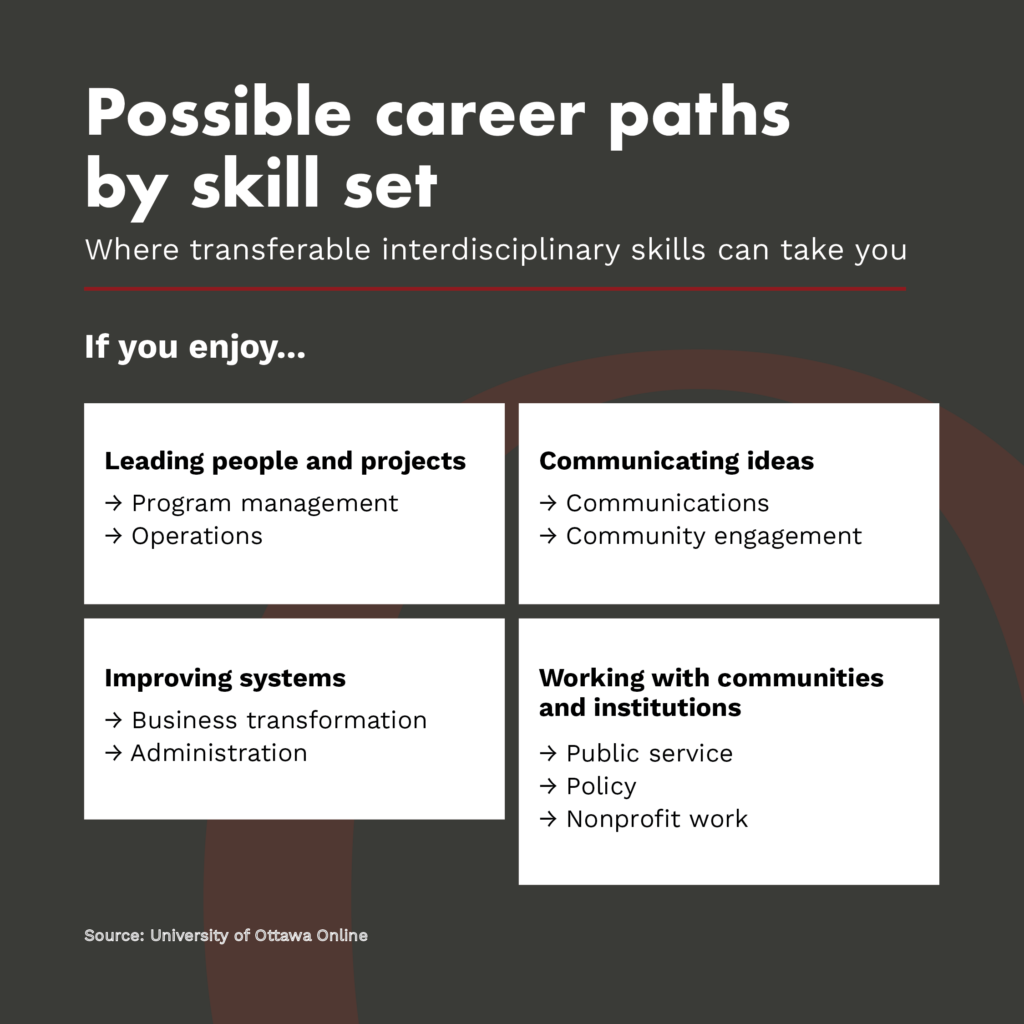
Potential directions can include program coordination and management, operations and administration, public service, policy-related work, health sciences avenues, communications, community engagement, nonprofit work and cross-sector leadership.
It can also provide a foundation for further graduate study or professional pathways, depending on future admission requirements.
The advantage is flexibility. Instead of preparing you for only one occupational category, the degree can help you build capabilities that travel with you as your role, industry or goals change.
What management career paths can an interdisciplinary degree support?
An interdisciplinary degree can support management-related paths where you need to understand people, priorities and information from several angles.
Program management, operations, business transformation and project or program coordination can all involve cross-functional work. You may need to translate between teams, weigh competing priorities, make decisions with incomplete information and keep people aligned around a shared outcome.
For graduates who already bring workplace experience, broader thinking and communication skills can complement the practical knowledge they’ve built on the job.
How can interdisciplinary studies prepare you for communications careers?
Interdisciplinary studies can prepare you for communications work by strengthening your ability to understand an issue before deciding how to explain it.
Strong communicators consider audience, context, purpose and potential impact. Studying areas such as culture, history, identity, social sciences and society can help you understand why different groups may interpret the same message differently.
That can be useful in corporate communications, public affairs, internal communications, community outreach and communications management, where strategy and stakeholder understanding matter alongside writing skills.
How can an interdisciplinary degree lead to public service and community engagement?
An interdisciplinary degree program can support public service and community-focused work by helping you understand complex issues from multiple stakeholder perspectives.
Public-sector and community roles often bring policy, communication, history, culture and ethics together. You may need to interpret evidence, understand how past decisions shape current realities and communicate with people who bring different needs or priorities to the table.
Those capabilities can be relevant to policy coordination, program delivery, public communications, nonprofit organizations and community initiatives.
How can Indigenous and cultural perspectives strengthen your professional toolkit?
Indigenous and cultural perspectives can strengthen your professional toolkit by broadening the histories, contexts and ways of understanding that you bring to complex issues.
At uOttawa, the Bachelor of Arts, Interdisciplinary Studies (Online, Accelerated) includes Indigenous thought alongside areas such as Canadian culture, global history, environmental studies and digital cultures.
That exposure encourages you to question assumptions, recognize how historical context shapes present-day decisions and approach work with communities and institutions more thoughtfully.
How can interdisciplinary approaches complement fields such as computer science and technology?
Interdisciplinary approaches can complement computer science and technology by adding human context to technical work.
This doesn’t mean an interdisciplinary studies major replaces technical education. Instead, it can help you work alongside technical specialists while asking questions about how technology affects people, organizations and society.
That can be relevant in technology-adjacent work such as project management, communications, operations, change management and stakeholder engagement.
Digital fluency paired with critical analysis can help you think not only about what technology can do, but how and where it should be applied.
How does interdisciplinary research strengthen critical thinking?
Interdisciplinary research strengthens critical thinking by requiring you to compare evidence, concepts and explanations from more than one field.
You learn to ask whether a single framework is enough to explain a problem. You also practise identifying assumptions, gaps and limitations in available information, then deciding which forms of evidence are most useful for the question in front of you.
That process can make you a more careful consumer of information, which is especially useful when information is abundant or generated by automated tools.
What might your academic journey look like in an interdisciplinary program?
Your academic journey can involve studying across multiple disciplines while continually connecting ideas back to larger contemporary questions.
For example, uOttawa’s Bachelor of Arts, Interdisciplinary Studies (Online, Accelerated) includes areas such as global history, Canadian culture, literature, architecture, environmental studies, Indigenous thought, digital cultures, ethics, agency, identity and society, plus communication, interpretation and critical analysis.
The focus is progressive skill-building rather than training for one predefined occupation.
How can the Faculty of Arts prepare graduates for careers across sectors?
The Faculty of Arts can prepare graduates across sectors by developing the human-centred capabilities used to interpret information, communicate, make decisions and understand context.
uOttawa’s Human Intelligence for Human Futures initiative emphasizes judgement, qualitative methods, critical thinking, communication, collaboration, and empathy in a world increasingly shaped by algorithms and AI.
That perspective aligns with a workplace where technical tools matter, but so does the human ability to decide what information means, how to use it and how decisions affect other people.
What are the admission requirements for an accelerated interdisciplinary degree?
For uOttawa’s Bachelor of Arts, Interdisciplinary Studies (Online, Accelerated), applicants need English proficiency, a two-year or three-year accredited Canadian college diploma and a minimum admission average of 63%.
Your previous credential also determines your pathway.
The 90-unit pathway requires 45 units of equivalencies for eligible two-year diploma holders, and the 120-unit pathway requires 60 units of equivalencies for eligible three-year diploma holders.
The program is delivered 100% online and takes 20 to 28 months to complete, depending on your existing college credential.
How can you decide whether interdisciplinary studies fit your career goals?
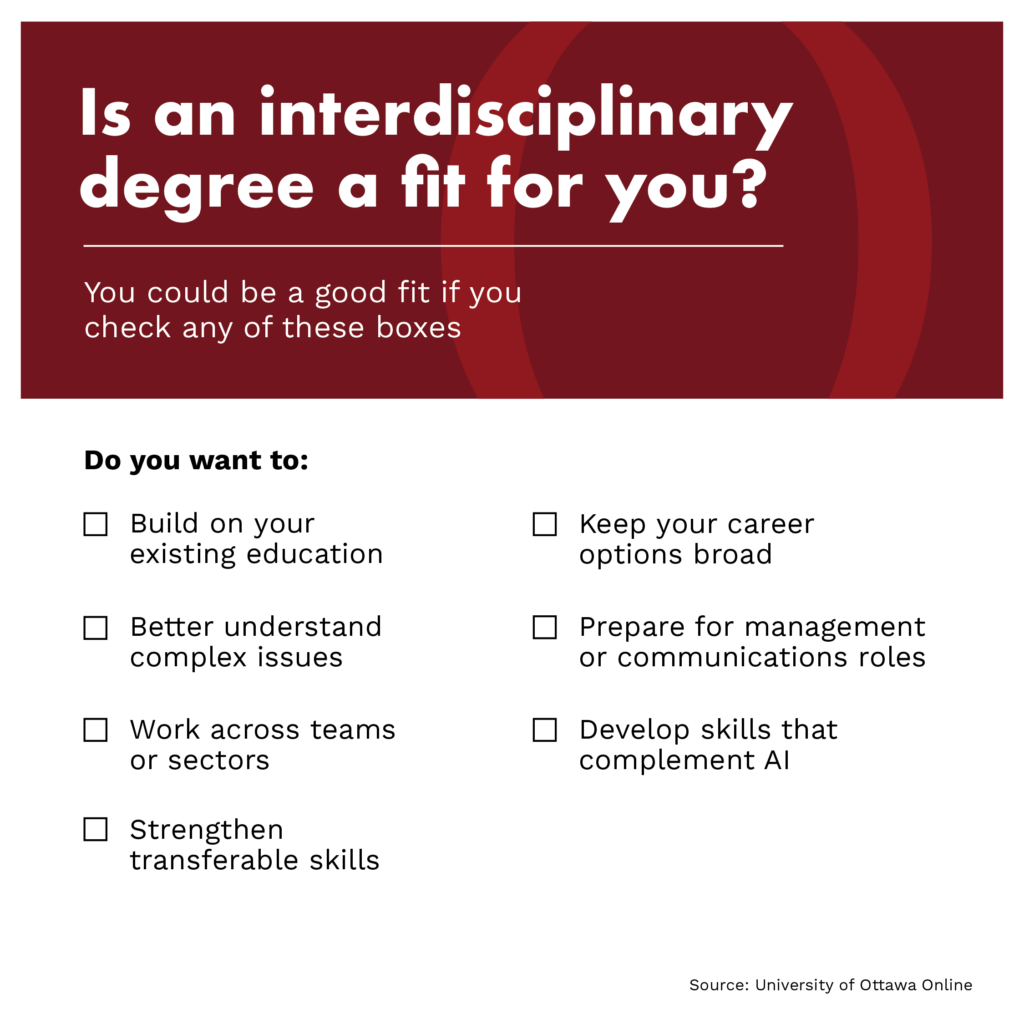
Interdisciplinary studies may fit your goals if you want broader capabilities that stay useful across roles, rather than training for one narrowly defined occupation.
Consider whether your next step requires stronger communication, analysis, management or problem-solving skills. Think about whether you enjoy connecting ideas from different fields and whether your academic interests span several functions or sectors.
A degree also matters when a bachelor’s credential itself opens additional opportunities, such as a gateway into graduate school or higher earning opportunities.
Statistics Canada reported that in 2024, employees aged 25 and older with a bachelor’s degree or higher earned $44.67 per hour on average, compared with $34.38 among those with postsecondary education below a bachelor’s.
Earnings for interdisciplinary majors vary widely by occupation, experience, location and other factors, so that difference shouldn’t be treated as a guaranteed outcome.
You could be a good fit if you check any of these boxes
Build on your college diploma with an interdisciplinary degree
If you’ve already earned a college diploma, you may be closer to a bachelor’s degree than you think.
uOttawa’s Bachelor of Arts, Interdisciplinary Studies (Online, Accelerated) is designed for college-credentialed adults who want to build on prior learning instead of starting over. You can study 100% online while strengthening transferable skills that can support career growth in a changing economy.
Request information to learn more about your pathway, admission requirements and next steps.
Key terms
Interdisciplinary studies: An approach that connects knowledge, perspectives and methods from multiple academic fields.
Interdisciplinary education: Learning designed to help you integrate ideas across disciplines rather than study them only in isolation.
Interdisciplinary research: The use of concepts or evidence from more than one field to examine a question or problem.
Digital fluency: The ability to use, understand and critically assess digital tools and information.
Cultural literacy: Knowledge and awareness that help you understand cultural contexts, perspectives and references.
Transfer credit: Academic credit granted for eligible previous learning, which can reduce the number of courses required in a new program.
Human-centred skills: Capabilities such as judgement, communication, creativity, empathy and critical thinking that rely heavily on human interpretation and interaction.