

Online learning
Jobs you can pursue with a Bachelor of Arts degree in Interdisciplinary Studies
Key takeaways
- An interdisciplinary arts degree can support career paths in management, operations, communications, public service, community engagement and nonprofit work.
- Interdisciplinary studies develop transferable skills such as critical thinking, communication, judgement, creativity and problem-solving rather than preparing you for only one occupation.
- Human-centred capabilities remain important as AI reshapes work, with analytical thinking, adaptability, leadership and creative thinking among employers’ most valued core skills.
- Your previous education and work experience can combine with an interdisciplinary degree to create a broader foundation for career growth.
- uOttawa’s Bachelor of Arts, Interdisciplinary Studies (Online, Accelerated) lets eligible college graduates build on their existing diploma instead of starting university from the beginning.
Choosing a degree doesn’t always mean choosing one job for the rest of your career. In a labour market shaped by AI, technological change and evolving workplace needs, the ability to think across subjects, understand context and adapt your skills can be valuable in many different settings.
That’s where an interdisciplinary arts degree has value.
Instead of pointing you toward a single occupation, it can help you build knowledge and transferable skills you can apply across management, communications, public service, community engagement and other people-centred fields.
What makes interdisciplinary studies relevant to today’s workplace?
Interdisciplinary studies are relevant because they teach you to draw on different perspectives when interpreting information, solving problems and making decisions.
That’s important when workplace challenges don’t fit neatly inside one subject area.
A project might require you to understand people, communicate with different audiences, weigh ethical considerations and respond to technological or organizational change at the same time.
Those capabilities align with what many employers say they need. The World Economic Forum reports that 69% of surveyed employers consider analytical thinking a core workforce skill. Resilience, flexibility and agility follow at 67%, with leadership and social influence at 61% and creative thinking at 57%.
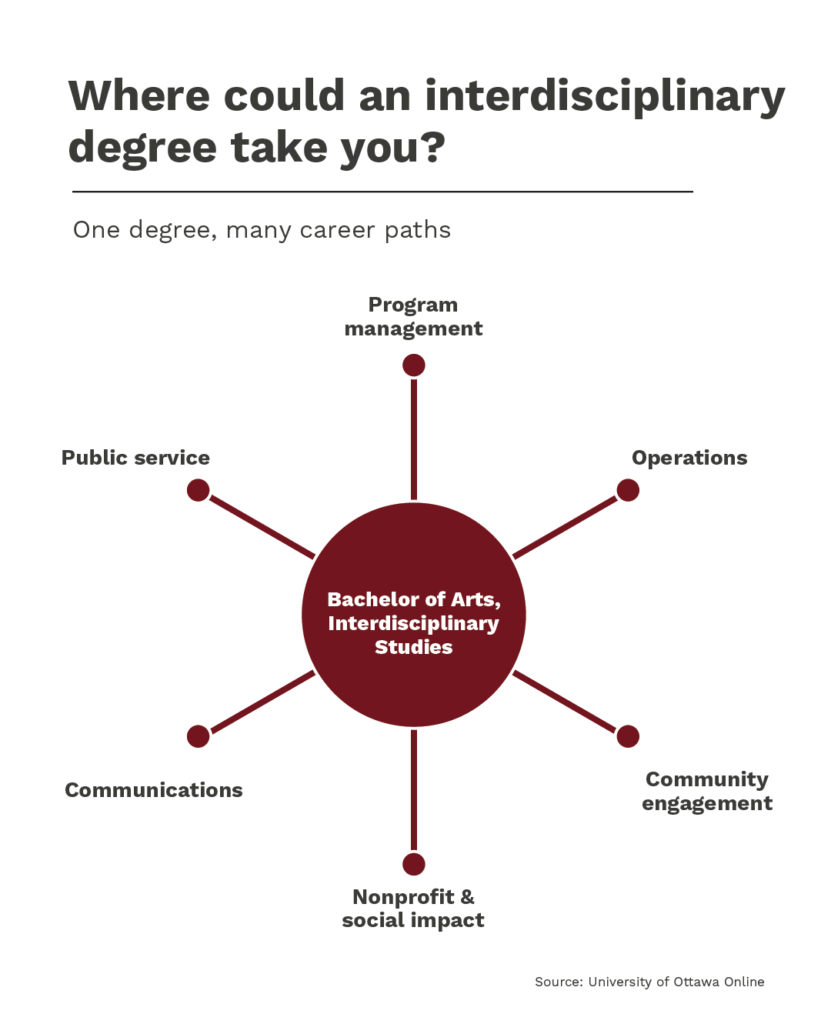
One degree, many career paths
What arts degree jobs can lead to careers in management and operations?
Management and operations career paths can suit arts graduates who enjoy coordinating people, priorities and processes while keeping larger organizational goals in view.
Interdisciplinary learning can be particularly useful when a role requires you to move between teams, understand competing needs and make decisions without relying on one narrow area of expertise.
What is a program manager?
A program manager coordinates projects, services or initiatives from planning through delivery.
Depending on the organization, that can mean managing timelines, aligning stakeholders, tracking priorities and helping teams translate broader goals into practical action.
The communication, judgement and problem-solving involved can make interdisciplinary skills relevant across government, nonprofit organizations, education, health care and private industry.
What does an operations manager do?
An operations manager helps people, resources and processes work together effectively.
The role can involve workflow planning, coordination, resource management and responding to changing organizational needs. Because operations exist in almost every sector, professionals often benefit from adaptable skills that carry across industries.
What is a business transformation coordinator?
A business transformation coordinator or manager supports organizations as they introduce new processes, systems or ways of working.
That may involve coordinating stakeholders, organizing change initiatives and helping different teams understand what’s changing and why.
As workplaces continue to adapt to new technologies and business models, the ability to think critically about both systems and people is valuable.
What arts degree jobs connect interdisciplinary studies and communications?
Communications careers can be a natural direction for people who can interpret context and turn complex information into clear messages.
However, strong communication isn’t only about writing well. Professionals also need to consider who they’re speaking to, what’s important to that audience and how different people may interpret the same information.
What does a communications manager do?
A communications manager plans and coordinates how an organization communicates with internal or external audiences. That can include shaping messages, supporting media or public communications and working with teams across an organization.
Interdisciplinary thinking can help because effective communication often requires understanding culture, context, organizational priorities and different perspectives.
What is a community engagement lead?
A community engagement lead builds relationships between an organization and the people or communities it serves.
The work may include outreach, partnerships, consultations, events or public-facing initiatives. Empathy, communication and the ability to understand different experiences are central to many of these responsibilities.
What arts degree jobs are available in public service and the social sciences?
Public service and social impact careers can draw on the research, communication and critical thinking skills developed through interdisciplinary study.
These roles often involve complex questions about people, institutions and communities.
Rather than relying on one technical specialty, professionals may need to research issues, coordinate programs, communicate with stakeholders and understand how policy decisions affect different groups.
What does a policy coordinator do?
A policy coordinator supports the research, development, implementation or administration of policies and programs.
Responsibilities can include organizing information, tracking initiatives, contributing to research and communicating with internal or external stakeholders. Similar skills can also support work in associations, nonprofits and other policy-influenced environments.
Nonprofit and social impact organizations can offer additional directions in program coordination, community outreach, partnership development, communications, advocacy support and administration.
What creative jobs can arts students pursue with an interdisciplinary degree?
Creative career paths aren’t limited to traditional artistic professions. Creativity is also valuable in roles that require fresh perspectives and thoughtful problem-solving.
You might apply those abilities in communications, content development, community engagement, program development or creative project coordination.
An interdisciplinary degree isn’t designed to train you for one specific creative occupation. Instead, it can help strengthen your ability to connect information from different sources and approach challenges from more than one angle.
How can environmental studies contribute to interdisciplinary career paths?
Environmental studies can broaden your understanding of complex challenges by examining how environmental issues intersect with people, institutions and society.
Studying environmental questions alongside disciplines such as culture, history, ethics and society can provide useful context for work connected to community initiatives, sustainability programs, public service, nonprofit organizations and cross-sector projects.
It’s a broader foundation rather than specialized professional training in an environmental field.
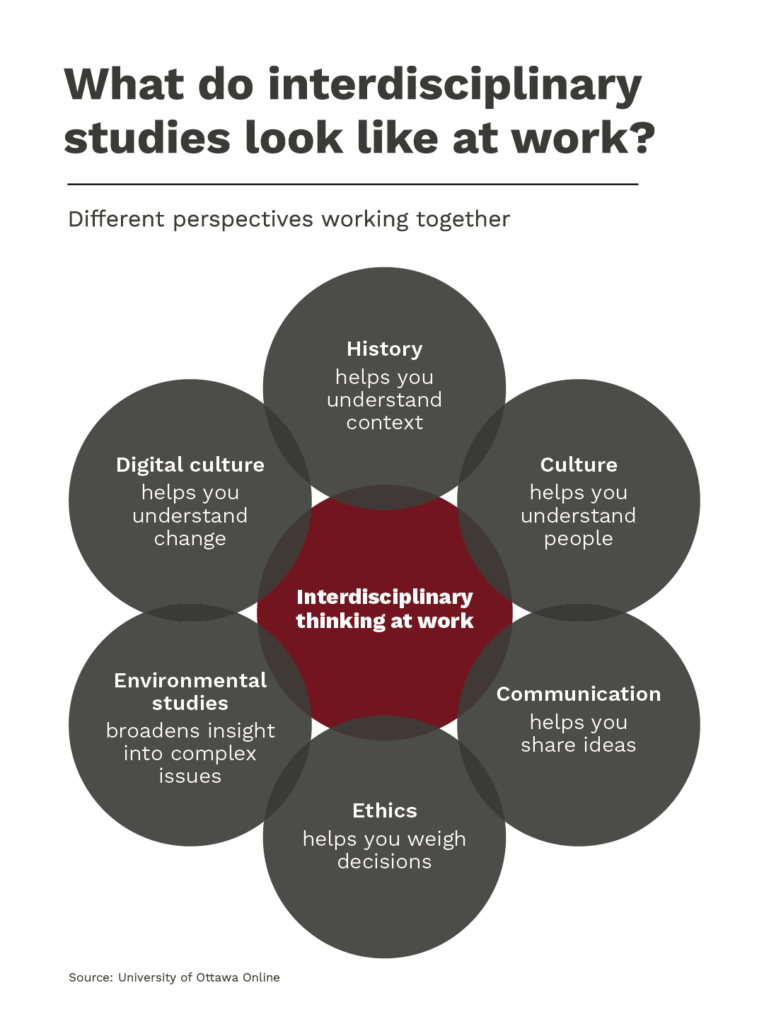
Different perspectives working together
How are interdisciplinary programs different from career-specific degrees?
Interdisciplinary programs build a broad set of transferable capabilities, while career-specific degrees generally focus more closely on a particular profession or technical field.
That difference can be useful if you expect your responsibilities or career direction to evolve. Rather than preparing only for one job title, an interdisciplinary academic program can strengthen critical thinking, communication, judgement, creativity and problem-solving that can remain relevant as you move between roles.
For experienced professionals, that breadth can also complement what you already know rather than asking you to adopt an entirely new professional identity.
How can an arts degree help you build on experience you already have?
An arts degree can add a university credential and broader academic foundation to the practical experience and college education you already have.
That combination may be especially relevant if you’ve built significant professional experience but are encountering opportunities where a bachelor’s degree is preferred or required.
Education level also remains linked to earnings in Canada, although it is only one of many factors that influence income. Statistics Canada reports that in 2024, employees aged 25 and older with a bachelor’s degree or higher earned an average of $44.67 per hour, compared with $34.38 per hour for employees with postsecondary education below a bachelor’s degree, which is roughly a 30% difference.
How can arts students decide which career path fits them?
Start by thinking about the kinds of problems, people and environments you want to work with rather than choosing based only on a job title.
Consider where your strengths naturally sit. Do you enjoy coordinating people and projects? Communicating ideas? Analyzing information? Building relationships? Helping organizations manage change?
Then look across several industries and compare job descriptions. Pay attention to recurring skills and degree requirements.
The goal here is to understand how your existing education, professional experience and developing interdisciplinary skills could combine into several realistic directions.
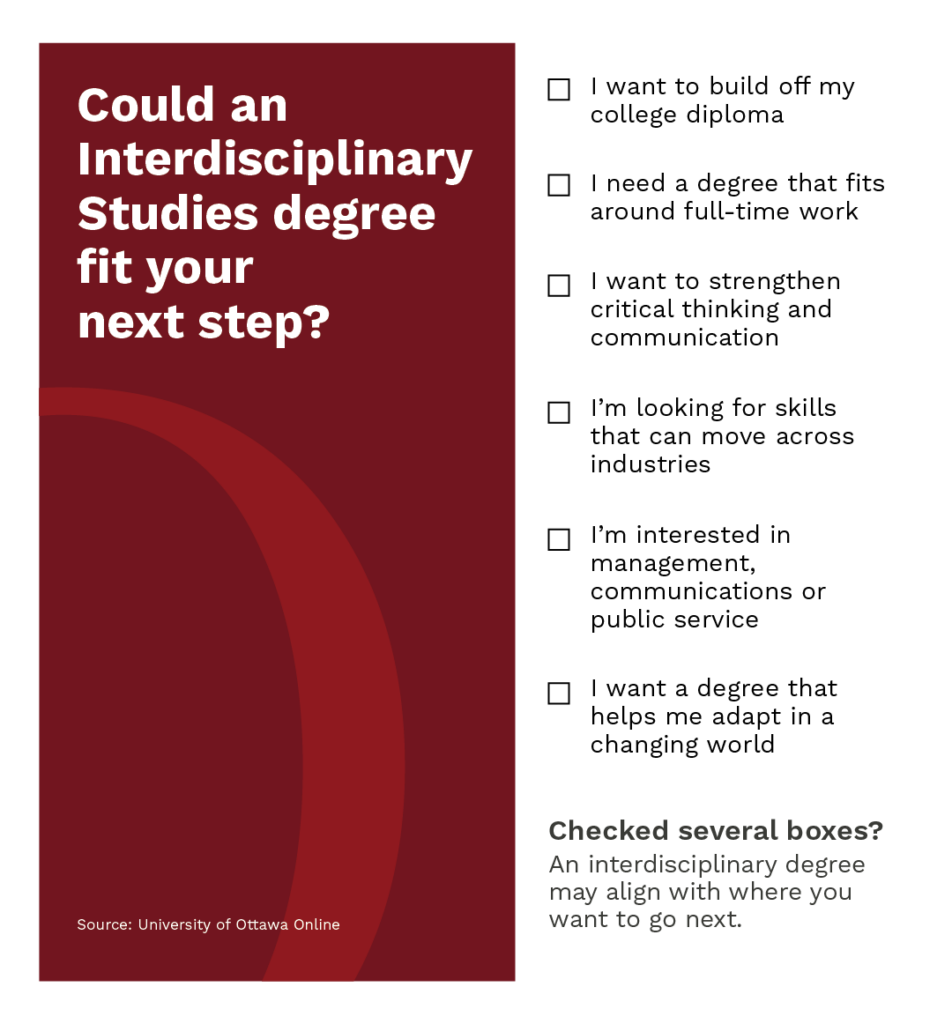
Take the next step toward a Bachelor of Arts degree at uOttawa
Your previous college education doesn’t have to be where your academic path ends.
The Bachelor of Arts, Interdisciplinary Studies (Online, Accelerated) at uOttawa is designed for college-credentialed adults who want to build on what they’ve already accomplished while strengthening the human skills increasingly valued in a changing workplace.
You can study 100% online while continuing to work and build toward a university degree that can support opportunities across roles and sectors.
Request more information to explore the curriculum, admission pathway and next steps.
Key terms
Interdisciplinary studies: An approach to learning that brings together knowledge and perspectives from multiple academic areas.
Interdisciplinary degree: A degree designed around multiple fields of study rather than one narrowly defined discipline.
Transferable skills: Capabilities such as communication, critical thinking and problem-solving that can be applied across different jobs and industries.
Critical thinking: The ability to evaluate information, question assumptions and reach reasoned conclusions.
Digital fluency: The ability to understand, navigate and work effectively in digitally shaped environments.
Community engagement: Work focused on building relationships and collaboration between organizations and the communities they serve.
Public service: Work that supports government, public institutions or services designed to serve communities.
Career mobility: The ability to move into different roles, levels of responsibility, industries or professional opportunities over time.